
AI Video Weekly Roundup — March 27, 2026
The week started with the industry still processing NVIDIA GTC. It ended with the first major casualty. On Tuesday, March 24, OpenAI announced it was shutting down Sora — the model that introduced most of the world to AI video generation in early 2024. The stated reason was compute reallocation toward robotics. The real reason was legible in the numbers. Elsewhere, ByteDance found a side door for Seedance 2.0, Luma dropped a meaningfully upgraded Ray model, and Washington’s copyright battle over AI training developed a new fault line.
Models covered: Sora · Luma · Seedance 2.0 · Regulation
💀 OpenAI Kills Sora
Sora launched publicly in December 2024 on a wave of awe. Fourteen months later it’s gone. OpenAI announced on March 24 that the Sora app and API would be shut down, citing a “shift toward world simulation research to advance robotics.” The real story was in the numbers that followed: at its peak, Sora was burning an estimated $15 million per day in inference costs. Over its entire lifespan as a commercial product, it generated approximately $2.1 million in in-app purchases.
User retention told the same story. Downloads peaked at 3.33 million in November 2025 — weeks after launch — then fell 66% to 1.13 million by February 2026. The 7-day and 30-day retention numbers were 2% and 1% respectively. Sora wasn’t just expensive to run. It wasn’t keeping the users it acquired.
The Disney deal collapsed with it. In December 2025, OpenAI announced a three-year licensing agreement granting Sora users access to over 200 characters from Disney, Marvel, Pixar, and Star Wars. The deal was celebrated in press releases from both companies. No money ever changed hands. Disney’s statement on shutdown was diplomatic: “As the nascent AI field advances rapidly, we respect OpenAI’s decision to exit the video generation business and to shift its priorities elsewhere.” The $1 billion investment the headlines trumpeted is dead.
OpenAI’s framing — that Sora compute is being redirected toward robotics and world simulation — points toward where the company believes AI infrastructure spending should go ahead of its likely 2026 IPO. Video generation is expensive, unproven as a consumer product, and legally exposed. AGI and robotics carry a more defensible narrative for a company at OpenAI’s valuation stage.
Why it matters: Sora invented the AI video hype cycle. Its shutdown is the first real data point on what happens when a frontier model goes to market as a consumer product without a clear path to sustainable unit economics. Every AI video company is now pricing strategy against a cautionary example. The important question isn’t whether Sora failed — it clearly did — it’s whether the failure was product-specific or structural. The retention numbers suggest the latter: even when AI video generation works, most people don’t come back for it.
🌍 Seedance 2.0 Goes Global — Minus the US
ByteDance has been threading a narrow corridor all month. After pausing Seedance 2.0’s global rollout in mid-March over Hollywood copyright pressure, the company moved ahead anyway. Starting March 23, Seedance 2.0 relaunched under a new name — Dreamina Seedance 2.0 — rolling out to markets in Africa, South America, the Middle East, and Southeast Asia through its Dreamina platform. The United States is specifically excluded.
The rebranding isn’t cosmetic. “Dreamina” distances the product from ByteDance’s direct brand in markets where Chinese-owned AI platform scrutiny is growing. The regional launch strategy lets ByteDance generate commercial traction and reach hundreds of millions of potential users without triggering the legal confrontation a US launch would bring.
Seedance 2.0 currently sits atop the Artificial Analysis leaderboard at approximately 1,269 Elo — above Runway Gen-4.5 and Veo 3.1. ByteDance’s engineers haven’t solved the copyright problem. They’ve routed around it geographically.
Why it matters: The highest-benchmark AI video model on the market is being deliberately withheld from the world’s largest AI content economy. For US creators, Seedance 2.0 is still something you read about but can’t use. For ByteDance, the global south rollout is a play for commercial scale and training signal while its US legal position remains unresolved. It won’t stay that way indefinitely.
⚡ Luma Ray 3.14: Faster, Cheaper, Native 1080p
Luma AI dropped Ray 3.14 this week — a meaningful generational update to its Ray 3 model line. Native 1080p output, generation speed 4x faster than the previous Ray model, and per-second pricing 3x cheaper. Luma also released Ray3 Modify alongside it: a hybrid AI workflow tool for performance and acting, designed to give brands and studios more control over scene continuity and character consistency across shots.
The release came alongside news of Luma’s new London office, following its $900 million Series C led by HUMAIN. That capital and this model release together make the positioning legible: not consumer app, but professional infrastructure priced for production volume.
The pricing change deserves emphasis. A 3x reduction in per-second cost isn’t an incremental update — it materially changes the economics of any production workflow using Ray at scale. Combined with 4x generation speed, Ray 3.14 resets what’s practical for commercial content teams working in volume.
Why it matters: While OpenAI was exiting the video generation business this week, Luma was making its model faster and cheaper. The contrast is the week’s subtext: the path forward in AI video isn’t consumer apps subsidized by inference burns. It’s professional infrastructure priced for production use. Luma’s moves this week look like a company that read the Sora story before it was written.
⚖️ Washington’s Copyright Fault Line Widens
Last week’s Blackburn draft bill — which would strip fair use protection from AI training on copyrighted works — now has a formal counterweight. The White House published its National Policy Framework for Artificial Intelligence this week, taking the opposite position: the administration’s stance is that AI model training on copyrighted material does not constitute infringement, and that courts — not Congress — should resolve the question.
Separately, Senators Adam Schiff and John Curtis introduced the bipartisan CLEAR Act. Rather than resolving the fair use question in either direction, it would require AI companies to publicly disclose which copyrighted works were used to train their models. Disclosure without liability — a middle path designed to attract votes from both sides.
Three incompatible positions now occupy Washington simultaneously: Blackburn (training is not fair use, legislate it), White House (training is fine, let courts decide), and CLEAR Act (disclose data, defer the fair use question entirely). Sora’s shutdown arrived in this context — adding a live data point that AI companies are already making major business decisions under copyright pressure, without waiting for legal resolution.
Why it matters: The copyright question is no longer a background issue for AI video companies — it’s an active legislative battle with irreconcilable positions across the executive and both parties in Congress. Seedance’s geographic workaround and Sora’s shutdown both reflect an industry that knows this fight is coming and is placing structural bets on the outcome.
📈 By the Numbers
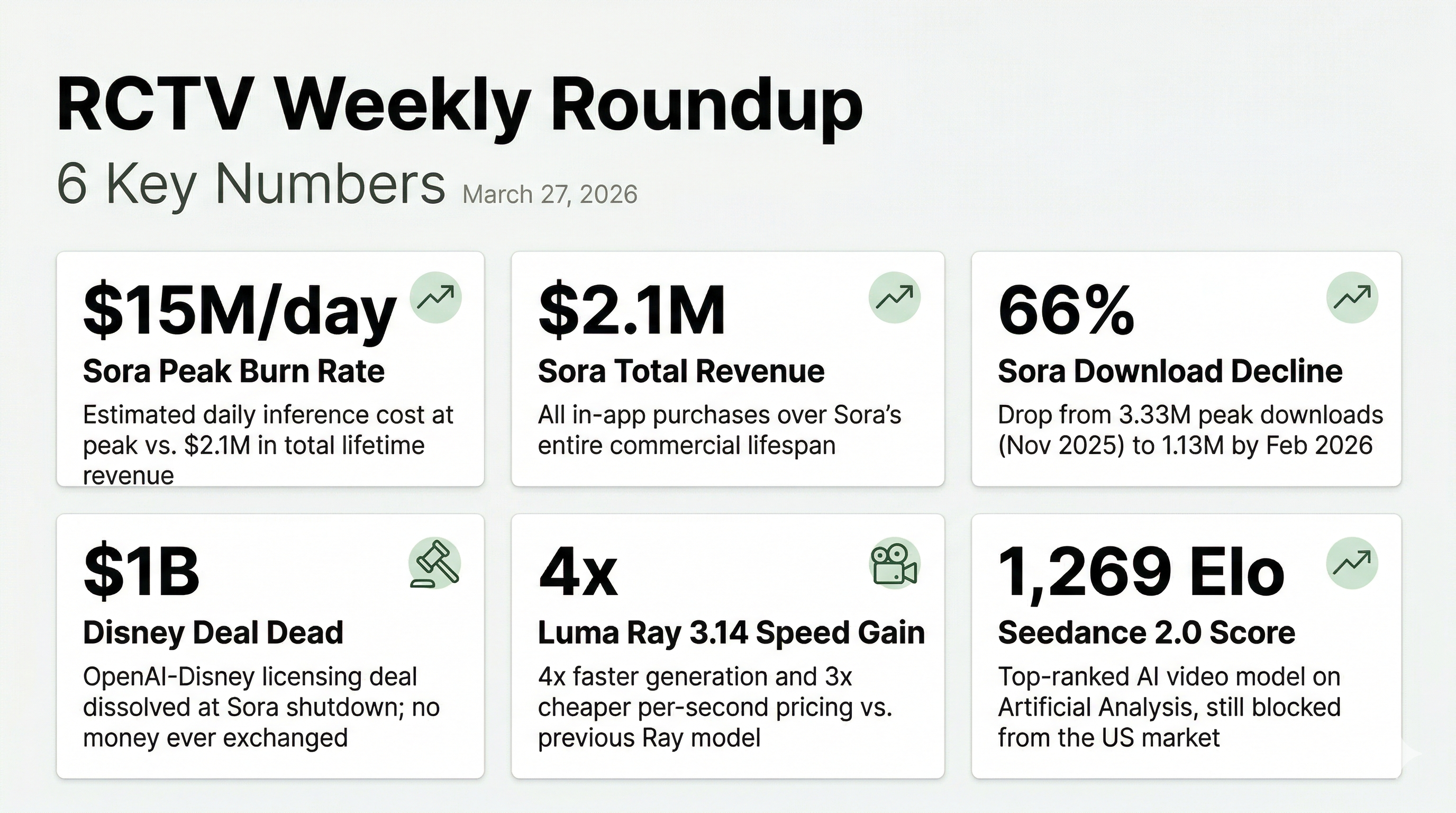
- $15M/day — Estimated peak inference cost for Sora — against $2.1M in total lifetime in-app revenue
- $2.1M — Total in-app purchases Sora generated over its entire commercial lifespan
- 66% — Drop in Sora monthly downloads from November 2025 peak (3.33M) to February 2026 (1.13M)
- $1B — Value of the Disney-OpenAI licensing deal announced in December 2025 — dissolved without a dollar changing hands
- 4x — Luma Ray 3.14 generation speed improvement, alongside a 3x reduction in per-second pricing
- 1,269 Elo — Seedance 2.0’s Artificial Analysis benchmark score — the top-ranked AI video model still inaccessible to US creators
🔮 What to Watch Next Week
- OpenAI’s video afterlife — The company says Sora compute is going toward “world simulation for robotics.” Watch for whether any video capability resurfaces inside ChatGPT, and what “world simulation” architecture actually means for future products
- Seedance 2.0 US timeline — ByteDance’s global rollout without the US is a holding pattern. The next move — lawsuit, licensing deal, or continued deferral — sets a legal precedent for the rest of the industry
- CLEAR Act traction — The bipartisan disclosure bill is the copyright compromise most likely to gain Senate momentum; watch for committee scheduling and additional co-sponsors
For full specs, pricing, and access details on every model covered this week, see the AI Video Generation Tools 2026 reference page — updated every Friday.
INFOGRAPHIC DATA
- $15M/day — Sora Peak Burn Rate — Estimated daily inference cost at peak vs. $2.1M in total lifetime revenue
- $2.1M — Sora Total Revenue — All in-app purchases over Sora’s entire commercial lifespan
- 66% — Sora Download Decline — Drop from 3.33M peak downloads (Nov 2025) to 1.13M by Feb 2026
- $1B — Disney Deal Dead — OpenAI-Disney licensing deal dissolved at Sora shutdown; no money ever exchanged
- 4x — Luma Ray 3.14 Speed Gain — 4x faster generation and 3x cheaper per-second pricing vs. previous Ray model
- 1,269 Elo — Seedance 2.0 Score — Top-ranked AI video model on Artificial Analysis, still blocked from the US market